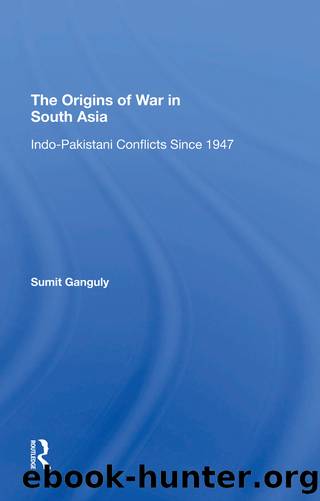
The Origins of War in South Asia: Indo-Pakistani Conflicts Since 1947 by Sumit Ganguly
Author:Sumit Ganguly [Ganguly, Sumit]
Language: eng
Format: epub
Tags: History, General, Asia
ISBN: 9780813385808
Google: GgVuAAAAMAAJ
Goodreads: 113913
Publisher: Westview Press
Published: 1986-01-01T00:00:00+00:00
Indian Defense Strategy
If the Pakistani geographical advantage was to be countered and the possibilities of tribal infiltration contained, what strategic doctrine was most appropriate? In answer to this question, Indian defense planners developed a twofold strategy in 1965. First, they decided not to discriminate between the Azad Kashmir forces and the Pakistani regular militia. The proximity of Pakistan to Kashmir and its shorter supply lines coupled with the ambivalence of the native Kashmiri population towards Indian rule necessitated this first decision. Second, the Indian strategy tried to raise the costs of a Pakistani invasion and thereby to deter hostile action of any sort. (For a longer exposition of these issues see Kavic, 1967, p. 36-39.)
To achieve these strategic goals, the Indian Army was deployed in the following fashion. Three infantry divisions were assigned to the Kashmir valley, Jammu and in the Poonch-Mindhar-Rajauri area across the northwestern salient. An additional infantry battalion was stationed at Leh. Apart from these front-line troop emplacements, a counterstrike force composed of two infantry divisions was based in Punjab and stationed in Ferozepore, Ambala, Jullunder, Amritsar, Kausali and Gurudaspur. The only armored division was stationed in Jhansi, south of New Delhi and was seventy-two hours away by train from its operational "take-off" point in East Punjab. (This discussion of force deployments has largely been derived from Kavic, 1967, p. 86.)
Indeed it appears that the primacy ol the army greatly influenced the nature of the Indian defense strategy. Initially, during the Rann of Kutch dispute opinion had developed in certain sections of the Indian government to expand the war beyond the Kutch region. Yet General Chaudhuri, the Army Chief of Staff, successfully staved off attempts to broaden the scope of the conflict, on the grounds that it did not make strategic sense. (Nayar, 1971, p. 169.) Simultaneously, Chaudhuri discussed the possibility of a Pakistani attack on Kashmir with Prime Minister Shastri and Defense Minister, Y. B. Chavan. On his own initiative, but with the consent of Shastri and Chavan, Chaudhuri took "appropriate steps" to meet the contingency of a Pakistani attack on Kashmir.
Thus, when the Pakistani attack came on September 1, Shastri unhesitatingly gave Chaudhuri the permission to carry the war into Pakistan by crossing the international border. As he later told his press secretary, Kuldip Nayar:
Pakistan mistook my desire not to fight as a sign of weakness; it thought that I will never go to war and it tried to take undue advantage in Kashmir. When it did so, I was convinced that Pakistan was not serious about good relations with India (and) I decided to act. (Shastri quoted in Nayar, 1972, p. 170.)
While the Indian Army was properly situated to cope with an attack on India's western borders there was a lack of coordination between the three services in terms of an integrated operations plan. Air Marshal P. C. Lai, Air Vice-Marshal in 1965, points out that though General J. N. Chaudhuri, the Chief of the Army Staff, made an accurate estimation of the Pakistani
Download
This site does not store any files on its server. We only index and link to content provided by other sites. Please contact the content providers to delete copyright contents if any and email us, we'll remove relevant links or contents immediately.
| Anthropology | Archaeology |
| Philosophy | Politics & Government |
| Social Sciences | Sociology |
| Women's Studies |
The Secret History by Donna Tartt(19083)
The Social Justice Warrior Handbook by Lisa De Pasquale(12190)
Thirteen Reasons Why by Jay Asher(8907)
This Is How You Lose Her by Junot Diaz(6885)
Weapons of Math Destruction by Cathy O'Neil(6279)
Zero to One by Peter Thiel(5800)
Beartown by Fredrik Backman(5751)
The Myth of the Strong Leader by Archie Brown(5507)
The Fire Next Time by James Baldwin(5442)
How Democracies Die by Steven Levitsky & Daniel Ziblatt(5218)
Promise Me, Dad by Joe Biden(5153)
Stone's Rules by Roger Stone(5087)
A Higher Loyalty: Truth, Lies, and Leadership by James Comey(4959)
100 Deadly Skills by Clint Emerson(4924)
Rise and Kill First by Ronen Bergman(4788)
Secrecy World by Jake Bernstein(4751)
The David Icke Guide to the Global Conspiracy (and how to end it) by David Icke(4717)
The Farm by Tom Rob Smith(4507)
The Doomsday Machine by Daniel Ellsberg(4490)
